
The 60-euro misconception
6,600 euros for an IKEA bed from the 80s. Knut Hagberg’s "Kromvik" cost the equivalent of 60 euros back then. Today collectors pay a hundred times that. Sounds absurd? It's not! Let's show you why.

© IKEA GermanyKEA Deutschland
In our workshop in Düsseldorf, old IKEA furniture regularly lands on the workbench. And we can tell you one thing: The 'Vintage IKEA' topic is real. But the market is also mercilessly inflated. We're cutting through the hype and showing you where genuine value lies and where you're simply paying for perceived nostalgia.
After this article, you’ll know which IKEA classics are worth your money, how to recognize real quality, and how not to fall for overpriced offers.
Why IKEA of all brands? The story behind the hype
IKEA and vintage – at first glance, they fit together as well as flat-pack furniture and craftsmanship. But here lies the misconception: Not everything IKEA was cheaply produced.
Between the 60s and 90s, IKEA worked with real design greats. Niels Gammelgaard, Gillis Lundgren, Knut Hagberg. Names that today cause excitement at auctions. These designers brought Bauhaus principles, pop art aesthetics, and Scandinavian minimalism into affordable furniture. Lundgren’s "Impala" chair is the perfect example: steel tubes, bright colors, clean lines. That was progressive back then, not makeshift.
What many don’t know: The production quality was different. The vintage IKEA hype is therefore not purely a nostalgia phenomenon. It is the rediscovery of an era in which "cheap" did not automatically mean "inferior."

© IKEA Museum | IKEA Germany
The 80s obsession: Why this particular era?
Cord upholstery, bright colors, geometric shapes – the 80s are back. Not just at IKEA, but across the entire vintage sector. And there are deeper reasons for this than mere retro-romanticism.
Cordula Meier, Professor of Art and Design Studies, sums it up: The 70s and early 80s were a time of crisis: Vietnam War, oil crisis, political unrest. Yet design retained a cheerfulness and optimism that now seems almost defiant. In times of climate crisis and geopolitical tensions, we long precisely for this naive courage.
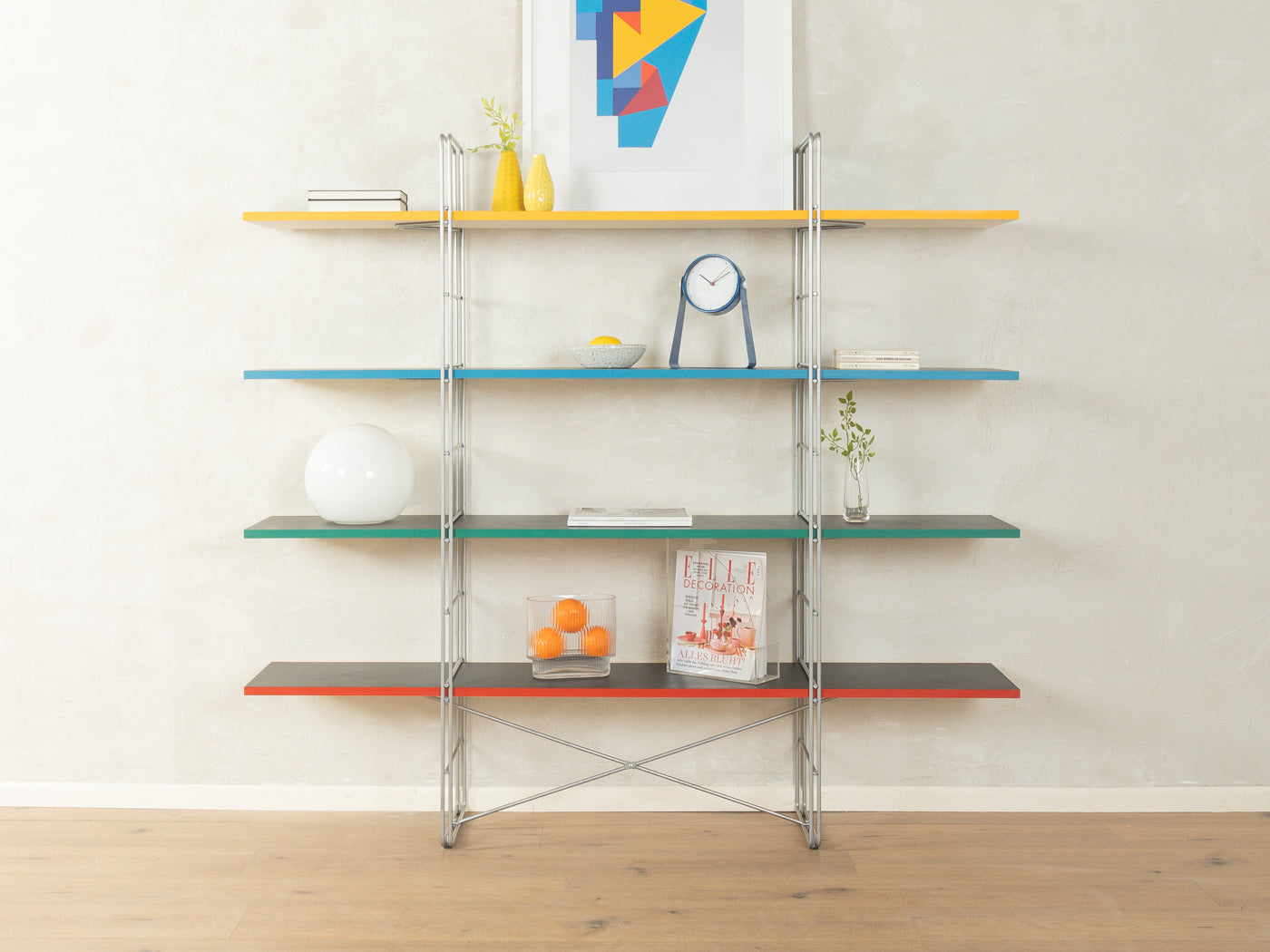
We also see this in our customers. People don’t just want a piece of furniture; they want a story. An anchor in their home. A tale from a time that was turbulent but manageable with the right ideas and a good dose of courage. The 70s and 80s stand for this flexibility – in thinking and living. Colorful shelving systems like the "Byakorre" (the reissue of the legendary "Guide") embody exactly that: adaptable, personal, unconventional.
But beware: not every orange sofa from the 70s is automatically valuable. What matters is the combination of designer name, material quality, and condition.
The inflated market: where prices become absurd
2,400 euros for an IKEA sofa – sounds crazy? We asked for it anyway. And sold it. Because we reupholstered and polished it. The customer paid not only for the collector’s value but also for 16 hours of manual labor.
The problem with the current market: many sellers demand top prices for unrestored originals. Often exaggerated. Especially if the metal parts have rust or the wood parts show water stains.
A mistake many make: confusing rarity with quality. Just because a piece is hard to find doesn’t mean it’s worth its price. We get inquiries for pieces offered online for four-figure sums – which on closer inspection are barely salvageable.
What you should pay attention to:
- Condition of joints: screwed or just glued? Still stable?
- Material quality: solid wood, plywood, or particleboard?
- Surface damage: superficial scratches or continuous cracks and breaks?
- Functionality: For sofas/armchairs – how is the padding really?
If a seller can’t or won’t provide detailed photos: steer clear. Reputable dealers will also show you the flaws.
IKEA Nytillverkad: The reissues compared
IKEA itself has recognized the trend and launched a retro collection called "Nytillverkad." The "Byakorre" shelf costs a tenth of the vintage price there.
We had both versions side by side: the original "Guide" from 1985 and the "Byakorre" from 2025. At first glance identical. On closer inspection: a few small differences. The original feels more solid, the metal parts are sturdier. As a result, the shelf is less wobbly.
By the way: Many "Nytillverkad" pieces are permanently sold out at IKEA. The company doesn’t reveal why. Maybe because demand exceeds supply. Maybe also because limited availability keeps the myth alive. Anyone who managed to snag one of the highly sought-after "Byakorre" is almost certainly holding something that will be a design classic by 2060 at the latest – even if it can’t fully match the original.
Our checklist – these IKEA classics are valuable
Have you set your sights on old IKEA furniture? Then a closer look might be worthwhile. Not every piece is worth gold, but you should know a few names and details.
Top designers promising value appreciation:
Niels Gammelgaard (Guide shelf, various seating furniture), Gillis Lundgren (Impala armchair, early classics), Knut Hagberg (Kromvik bed, statement pieces)
Production period:
Everything between 1960 and 1995 is potentially interesting. Especially the 70s and early 80s.
What really has value:
Statement designs with a clear design language. Also limited series and furniture with metal-wood combinations.
Let us tell you some interesting details about the vintage IKEA classics we have in our range. As you will notice, we mainly focus on Niels Gammelgaard:
Vintage IKEA Legends: The Stories Behind the Collectibles
Kromvik Bed (1981) – The Minimalist Dream in Chrome
Designed by Knut Hagberg, the Kromvik Bed embodies the spirit of the 80s: geometric, cool, uncompromising. The Swedish designer created a steel tube bed that deliberately broke with the cozy wooden beds of previous decades. The chrome-plated tubes and clear lines recall Bauhaus and the furniture of Marcel Breuer – but for the mass market.

Why a collector's item? The Kromvik is a statement piece that perfectly captures the spirit of the 80s: technoid, optimistic, future-oriented. It was never a bestseller – too polarizing. That is exactly what makes it valuable today. It was produced only for a few years, and many pieces ended up in the scrap heap because the chrome is prone to rust. Well-preserved pieces are rare and therefore highly sought after. The current record price of 6,600 euros shows: here you pay not only for furniture but for a piece of design history.
IKEA PS 1999 Collection – Experiment Becomes Cult
The PS collection (Post-Scriptum) was IKEA's design lab: designers were allowed to experiment without regard for production costs. The PS 1999 produced iconic pieces – from the foldable pendant lamp to modular furniture that looked like spaceship interiors.
Why collectibles? The PS series were limited and never mass-produced. They show IKEA from a different side: bold, innovative, design-driven rather than price-driven. Anyone who owns a PS 1999 piece today has a piece of IKEA avant-garde, and that is exactly what gives it value. These pieces were ahead of their time and still feel fresh today.
Guide Shelf (1985) – Niels Gammelgaard's Masterpiece
Niels Gammelgaard is one of the greats in the IKEA design cosmos, and the Guide Shelf is his best-known work. Minimalistic, clear, and timeless. A shelving system that fits into any home and still has character. The combination of metal rods and colored or white and black wooden shelves was innovative at the time. Today, the shelf is a design icon.

Why a collector's item? Form follows function, nothing is superfluous. It was flexibly usable – from bookshelf to room divider solution – and lasts forever if well cared for. In our workshop, we had Guide shelves that were still stable and colorful even after 40 years. IKEA reissued the design in 2025 as Byakorre. A sign of how strong the demand is. But collectors want the original: the heavier steel rods, the better robustness, the slight patina of time.
AXVALL rocking chair (1999) – Space Age meets Gammelgaard
The AXVALL Rocking Chair is Niels Gammelgaard's most futuristic and provocative IKEA design. The chair was created around 1999 as part of IKEA's Experiment series, where designers were allowed to work without the usual budget and mass production constraints.
The AXVALL is pure space-age aesthetics: an oversized, disc-shaped steel tube frame that looks like a UFO. The seat consists of a mesh of stretched bungee cords (elastic wire) that adapt to the body. No padding, no wood – just metal and rubber. The frame is usually painted white, more rarely in military green.
The shape is radical: the chair does not rock back and forth in the classic way but tilts in all directions – a 360-degree movement that you have to learn first. It is as far from a traditional rocking chair as possible. That was exactly Gammelgaard's intention.

Why a collector’s item?
-
Part of the PS collection – IKEA's design elite The IKEA PS series was never meant for the masses. They showed what IKEA can do when budget is no object. The AXVALL was only on the market from 1999 to early 2000 – barely a year. This makes it an absolute rarity.
-
Uncompromising futurism The AXVALL is extremely polarizing. Many find it uncomfortable, too daring, too "different." It is precisely this uncompromising nature that makes it a cult object. It is not a piece of furniture for everyone.
-
Surprising comfort The bungee cords are elastic enough to support the body and tight enough to provide stability. Those who embrace it discover an unusually comfortable seat – completely without traditional padding. The design was ahead of its time: today mesh furniture (like on modern office chairs) is standard, back then it was radical.
Moment Sofa (Niels Gammelgaard) – The misunderstood modernist
The Moment Sofa by Niels Gammelgaard is one of the most controversial IKEA designs of the 80s – and exactly for that reason a sought-after collector's item today. While other designers focused on coziness, Gammelgaard dared the opposite: a sofa that looks like a sculpture.
The Moment sofa follows Gammelgaard’s characteristic design language: clear lines, steel construction, geometric precision. The metal frame carries modular upholstered elements reduced to the essentials. No playful curves, no lush padding. Instead: an almost industrial aesthetic that combines Bauhaus and postmodernism.
The seat is firm, the backrest rather narrow – the Moment was never meant as a "cuddle sofa," but as a statement piece for people who prioritize design over comfort. It is a sofa that demands attitude. In both senses.

Why a collector’s item?
-
Polarizing design = cult status The Moment was not a commercial success. Too uncomfortable, too cool, too uncompromising for mass taste. It is precisely this uncompromising nature that makes it valuable today.
-
Niels Gammelgaard at his peak In the 80s, Gammelgaard had free rein at IKEA to experiment. The Moment sofa shows him at the height of his creative power: bold, radical, unsellable to the masses – but perfect for design enthusiasts.
-
Rarity value Because the Moment was never a bestseller, only a few examples were produced. Today, there are hardly any well-preserved pieces left – and the few that exist are guarded like treasures.
Conclusion: Hype with substance – but don’t buy blindly
Vintage IKEA is not a marketing trick. The quality of old IKEA designer furniture is real, and so is the sustainability. But it requires a trained eye. The market is overheated, and not every price is justified.
When you invest in Vintage IKEA: Buy with sense, not emotion. Check the condition, question the prices, invest rather in professionally restored pieces than in supposed "bargains" in original condition.
The key insights: Designer names like Niels Gammelgaard, Knut Hagberg, and Gillis Lundgren are your compass. Production periods between 1960 and 1995 promise the greatest potential. And condition is everything – a Moment sofa in need of restoration is not a bargain, but a project.
What we keep noticing in the workshop: People don’t just buy furniture, they buy stories. A Guide shelf tells of a time when IKEA prioritized design over profit margins. A Kromvik bed reminds us that not everything has to please everyone. These pieces have character – and that’s exactly what makes them valuable.
Our outlook: The market will calm down but not disappear. The true classics will retain their value, while overpriced speculative items will lose appeal. The Nytillverkad collection shows that IKEA itself has understood the heritage that lies dormant. Those who own a well-preserved original today or invest wisely will likely have a museum piece in their living room in 20 years.